
Conpono Cervical Collar
A 3D-scanned, patient-fitted cervical collar redesigned so users with neck weakness don't have to choose between support and mobility.

Human Factors
Medical Device Design
3D Scanning

Conpono Cervical Collar
A 3D-scanned, patient-fitted cervical collar redesigned so users with neck weakness don't have to choose between support and mobility.
Human Factors
Medical Device Design
3D Scanning


Prototype progression


Highlights:

Holds a filed utility patent;
actively seeking manufacturing partners and investors to advance the project
Designed from 3D scan data of real patients
Originated in Jefferson University's Jeffsolves program; completed independently as graduate thesis
Presented at Delve during Philly Design Week '22
%20(1)_edited.jpg)
Prototype progression
Highlights:
Holds a filed utility patent;
actively seeking manufacturing partners and investors to advance the project
Originated in Jefferson University's Jeffsolves program; completed independently as graduate thesis
Designed from 3D scan data of real patients
Presented at Delve during Philly Design Week '22
Context:
Every cervical collar on the market forces users to choose between support and mobility. Conpono was designed so they don't have to.
There is no clinical standard for patients who need cervical support long term. Medical grade collars are designed for acute injury and immobilization. Consumer grade options exist, but still don’t address the root problem: Patients that can move their neck but need support experience unnecessary restricted movement due to current collar designs.


Dropped Head Syndrome (isolated neck extensor myopathy) is the loss of innervation and/or muscle deterioration in the muscles of the neck, interfering with horizontal eye gaze. It’s associated with many neuromuscular diseases, aging, and directly impacts a patient’s quality of life.

Ron has ALS. When his neck muscles deteriorated to the point where he could no longer hold his head up on his own, he was fitted with a cervical collar and lost the ability to look down at his dinner plate. To eat, he had to remove the collar entirely, hold his head up with one hand, and manage his food with the other, unable to cut his own meal despite having full hand mobility.
ALS is a progressive disease, and his mobility and independence are prematurely being taken away from the lack of an adjustable collar.


Sue has spinal stenosis and osteoarthritis. Without support, she rests her head on her arm to work at her computer, curving her spine and compounding her pain. Even though their conditions differ, both Ron and Sue represent a patient population that current collars fail entirely: people who need neck support but still have and want their mobility. Research and patient interviews revealed the successful design criteria needed to create a device that comfortably and confidently engages users in daily activities.
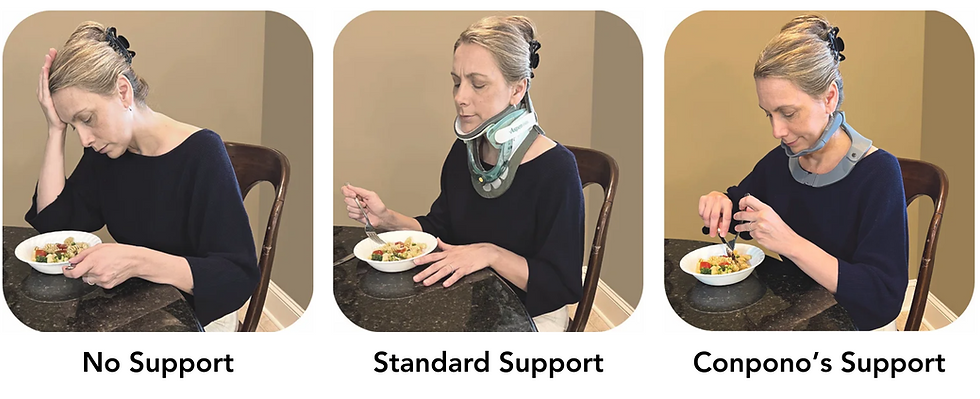
Role:
The Conpono began as a team project during JeffSolves, Jefferson University's program pairing design and medical students to develop medical devices, where I served as prototyping lead and contributed to research and patient interviews. When the program ended, I continued the project independently as my graduate thesis, taking full ownership of every subsequent phase: defining collar functions, user scanning, form development, mechanical iteration, prototyping, and patent filing.

Constraints:
There were 4 non-negotiable areas the Conpono needed to address and execute. First, pressure points: The form of existing collars concentrates pressure on the clavicles and sternum. While uncomfortable for the short term use they’re designed for, the long-term wear of the Conpono patient population results in pressure points, bruising, and ulcers. Every form decision had to balance distributing that pressure across a wider surface area while preserving enough arm and shoulder blade mobility that the collar wouldn't shift, lift, or create new pressure points during movement. The goal is to encourage mobility, not hinder it.
Secondly, wearing the Conpono needed to boost confidence. Patients consistently requested a low-profile design that could be concealed under clothing, a significant challenge for a device that necessarily sits at the face and neck.


Beyond the form, the third factor was restoring independence with ease of use: Despite looking completely different, medical grade and over the counter collars share the same fundamental donning and doffing problems: no reference points, blindly looking for connections, and requires users to lift their arms very high. The Velcro construction also ties neck width adjustment directly to the attachment process, meaning fit changes every single time the collar is removed and reapplied.
For Ron, needing a caregiver to put on and take off his collar was not a minor inconvenience, it was a direct loss of independence in a disease that was already taking it from him. The Conpono’s reference points, magnetic guidance, and tactile feedback were not enhancements but requirements.


Lastly, the collar needed to be able to be adjusted by the user, while being worn, in multiple angles looking down. The new design needed to integrate a precise adjustable mechanism onto asymmetric, biomorphic geometry.


Process:
At the close of JeffSolves, the team had a functional prototype and an aspirational form to build towards. My independent phase began with establishing the correct pivot point location and constructing that form, only to quickly realize that a thorough audit of the don and doff process was the real next step. The findings from that audit sharpened and expanded the design criteria, giving the redesign a much more specific functional foundation.


Phase two began with a controlled test, using a proof of concept prototype built from 3D printed parts and off the shelf components. Its purpose was to reduce high risk areas by isolating and evaluating pivot location, pressure distribution, and the new donning and doffing process. I used a 3D scan of my own geometry as the reference base, establishing the scanning workflow I would later use with patients.


Proof of Concept Prototype


What phase two confirmed was as important as what it disproved. The pivot location was validated. The adjustment mechanism was not. Fixed ten degree increments and an inward press to unlock tested as unnatural in use, and that single finding became the driving brief for the mechanism evolution that followed.


Phase three introduced the human form as the primary design input. After scanning Sue, I developed the collar trim lines directly from her geometry, using the scan data to widen the pressure bearing surfaces and distribute load away from the clavicle and sternum. A biomimicry study of the primary neck muscles informed the overall form language.

Base & Neck Development


Pivot Actuator Development


Chin Support Development


The mechanical challenge of this phase was considerable: flat precision components needed to integrate onto surfaces that follow the asymmetric curvature of a real body, requiring a new modeling workflow in CAD and many iterations of tolerance adjustment. The adjustment mechanism was redesigned from fixed increments to a patented spring based system with infinite range that locks automatically on release. Tactile and magnetic cues were built into every interaction point so the collar could be operated fully independently by users with limited arm mobility.


Hinge Integration


Outcomes:
Every design decision in this project was made in service of one outcome: a collar that Ron and Sue could wear through their actual lives, not just through a clinical scenario. The result is a patented, patient-fitted device with infinite angle adjustment, independent operation, and a low-profile form designed to be worn long term. The initial JeffSolves work was presented at Delve during Philadelphia Design Week in October 2022, and independent development has continued since. Active areas of development include optimizing the patient scanning workflow, refining fit, and integrating padding for long term wear comfort.


The Conpono is the project I could talk about forever, and my 180+ page process book is proof of that. It documents every research finding, prototype phase, and design decision in full. Please reach out if you are curious to see the full depth of the process!
The Conpono is the most complete expression of the design philosophy that runs through all of my work: that listening closely to what patients actually need, in their actual lives, is what leads to solutions that are both more humane and more functional. Manufacturing partners and investors are actively being sought to move the project into its next phase.


